

Memorizing the Quran is an honour for every Muslim and a lamp that lights their path in life, guiding them to what they need and giving them what they ask, for it is noble and comes from the Most Noble. Whoever memorizes the Quran takes on its character even without meaning to, and their soul is refreshed by its meanings and purposes, so it sets right a great deal within them and mends what is broken in them, smoothly and gently, by the leave of the Most Gentle, the Restorer (Al-Latif, Al-Jabbar).
And because the Quran is precious, it deserves special attention and a fixed time in our day that belongs to it alone, shared with nothing else, when we give our minds to nothing but it. So anyone who memorizes the Quran, or wishes to, should set and follow a specific plan, or a Quran memorization schedule that suits their circumstances.
It is important to realize that there is no particular age for memorizing the Quran: our noble Prophet did not receive revelation until the age of forty, and there are many true stories of people who memorized the entire Quran after the age of fifty or sixty. Nor is there a set period for memorizing the Quran: some memorize it in five years, and others in five months or less. The secret lies in regularity, willpower and dedication, and, before all that, in supplication: asking Allah, glorified and exalted is He, to make memorizing it easy for us and to open its doors to us, for nothing in the universe happens except by His leave alone, glory be to Him.
No doubt you are now wondering about practical steps and a specific plan for memorizing the Quran. Don’t worry: we will set out a number of specific, practical models for memorizing the Quran. But before laying out Quran memorization schedules over different timeframes, I would like to stress a few points that are the pillars you need to join those who have memorized the Quran and crown your parents with the crown of honour. Without them, neither we nor you will be able to carry out a Quran memorization schedule and move forward in memorizing.
The pillars of becoming one who has memorized the Quran
Our sheikhs and female teachers have always stressed to us that success comes from Allah alone, and that the first and most important thing we must understand well is that the first step in anything, on any path, begins with your connection to Allah, glorified and exalted is He; that we must keep this truth in mind and constantly remind ourselves of it so we do not stray from the path; and, finally, that we draw strength along the way from good companions. Accordingly, we can divide the pillars of earning the honour of memorizing the Quran into three, as follows:
1- The pillar of your connection with Allah
The first and most important pillar on which we will build our memorization of the Quran is a spiritual one, tied to our connection with Allah, glorified and exalted is He. It is as follows:
a. Making your intention in memorizing sincerely for Allah; and there is much good in having many good intentions
b. Seeking Allah’s help and asking Him for success and for openings
c. Being truly determined to memorize
d. Being mindful of Allah (taqwa) and keeping away from sins and wrongdoing
2- The pillar of your connection with yourself
The second pillar of memorizing the Quran relates to your connection with yourself: knowing yourself and how to deal with yourself to reach the goal you seek. It is as follows:
a. Setting a clear goal for memorizing the Quran, to drive you whenever your resolve weakens
b. Knowing your ability to memorize and your daily schedule, so you can choose the Quran memorization schedule that suits you best
c. Knowing the memorization method that suits you best and lets you memorize quickly
d. Your willpower and taking practical measures, such as setting a fixed time for memorizing and memorizing from one particular Mushaf … and other means that help you memorize and retain
3- The pillar of your connection with people
We live among people; we are influenced by them and we influence them. That is the nature of life, so our connection with the people around us matters and has a great effect on our lives and achievements, even if we are not aware of it; but it is the truth. In a hadith narrated by Ahmad and others, the Prophet (peace be upon him) said: “A person follows the religion of his close friend, so let each of you look at whom he takes as a close friend.” So if you want to memorize the Quran, do not neglect the following:
a. Good companions who, if they do not join you in doing good, will not hold you back from it.
b. Companions who are also memorizing the Quran, who help you and whom you help, as you race together on the path of Allah and for His sake
c. A sheikh or teacher: however old and mature you become, never give up having a sheikh to guide you, or a teacher, on your path with the Book of Allah
Download the Moddakir app and follow up your memorization with a proficient teacher
A Quran memorization schedule in practical steps
At last we have reached the practical steps for setting a Quran memorization schedule. We have made sure to offer several model schedules over different timeframes for you to choose from, as well as a model that shows you how to draw up your own memorization schedule.
As we all know, the Quran is divided into 30 parts (juz’), each juz’ is divided into two hizbs, and a hizb is 10 pages. So half a hizb is 5 pages, a quarter of a hizb is two and a half pages, and finally an eighth of a hizb is one and a quarter pages. These are the divisions we will rely on in the memorization schedules below
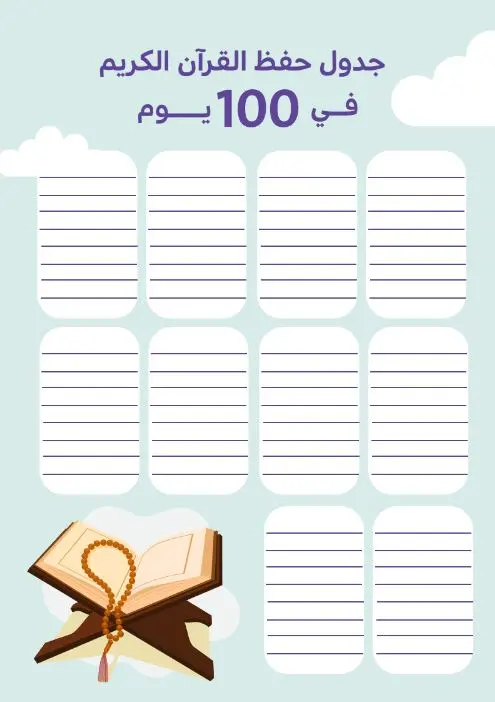
A- A schedule for memorizing the Quran in 100 days
100 days is considered the shortest commonly recognized period for memorizing the entire Quran. According to the book “Al-Hifz al-Muyassar lil-Qur’an al-Mudhakkar”, we can follow a simple schedule to memorize the whole Quran in three months and ten days. In the 100-day Quran memorization schedule, the book’s author relies on increasing the amount memorized gradually, as follows:
- The first ten days of the schedule:
Goal: memorize one hizb and an eighth of a hizb
Here we memorize an eighth of a hizb a day (about one and a quarter pages) every day for nine days, and the tenth day is a revision day, on which we revise all nine eighths (about 11 and a quarter pages).
- The second ten days of the schedule:
Goal: memorize two hizbs and a quarter of a hizb
In the second 10 days, the amount we memorize increases: we memorize two eighths of a hizb (a quarter of a hizb) every day for nine days, and on the tenth day we revise everything memorized during the second 10 days of the 100-day Quran memorization schedule.
- The third ten days of the schedule:
Goal: memorize 3 hizbs and 3 eighths of a hizb
We keep increasing the amount: in the third 10 days of the schedule we memorize 3 eighths of a hizb (about a quarter of a page short of 4 pages) every day for nine days, and on the tenth day, as usual, we revise everything memorized during the third ten days of the 100-day Quran memorization schedule.
Here, at the end of the first month, we have memorized 3 juz’ and three quarters of a hizb
- The fourth ten days of the 100-day Quran memorization schedule:
Goal: memorize 4 and a half hizbs
With the same increase, we add an eighth of a hizb a day: we memorize 4 eighths of a hizb, that is half a hizb (5 pages), every day for nine days, and on the tenth day we revise everything memorized during the last nine days of the 100-day Quran memorization schedule.
- The fifth ten days of the schedule:
Goal: memorize about 5 and a half hizbs
This is the last increase in the amount we memorize: we memorize 5 eighths of a hizb (about 6 and a quarter pages) every day for nine days, and on the tenth day we revise everything memorized so far during the last nine days of the 100-day Quran memorization schedule.
- The sixth ten days of the schedule:
Goal: memorize about 5 and a half hizbs
We memorize 5 eighths of a hizb (about 6 and a quarter pages) every day for nine days, and on the tenth day we revise everything memorized so far during the nine days before it in the 100-day Quran memorization schedule.
Here we have reached the end of the second month of the schedule and have memorized about 15 juz’. Congratulations on memorizing half of the Quran!
- The remaining forty days of the 100-day Quran memorization schedule
For the rest of our schedule, we carry on in the same way until the end of the 100 days: we memorize 5 eighths of a hizb a day, and on every tenth day we revise what we memorized in the nine days before it, that is 45 eighths of a hizb, until we complete the whole Quran.
B- A schedule for memorizing the Quran in 6 months
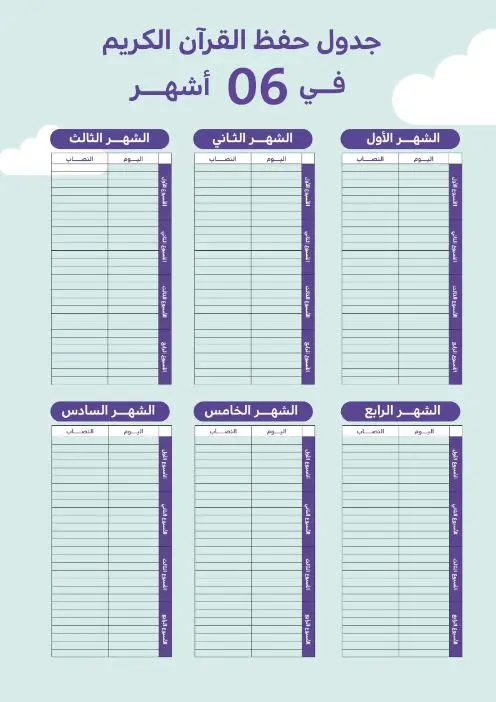
Some may find it hard to memorize according to the 100-day schedule and may prefer a longer period that suits their circumstances and ability to memorize, or perhaps one that gives them more time for revising and consolidating. With the following steps we can set out a 6-month Quran memorization schedule. In this schedule, the amount memorized is the same from the first day to the last, and our goal is weekly: to memorize 24 pages (about two and a half hizbs).
- Week one of the 6-month Quran memorization schedule
Here we memorize 4 pages a day for 6 days, and on the seventh day we revise everything memorized, which is 24 pages. In this way we will have memorized more than a juz’ and revised it within just one week.
- Week two of the 6-month Quran memorization schedule
In the second week we do the same: we memorize 4 pages a day for 6 days, and on the seventh day we revise everything memorized, which is 24 new pages.
- Weeks three and four of the 6-month Quran memorization schedule
Likewise, in each of weeks three and four we memorize 4 pages a day for 6 days, and on the seventh day we revise everything memorized, which is 24 new pages. In this way we will have memorized more than a juz’ and revised it within just one week.
Here, at the end of the first month, we have memorized nearly 5 juz’.
Likewise, in the second, third and all the way to the sixth month of the schedule, our goal is to memorize 5 juz’ a month in the way described above. And by the end of the sixth month, congratulations on memorizing the entire Book of Allah.
C- A schedule for memorizing the Quran in one year
Naturally, since the memorization period is longer, the daily amount is smaller than in the two previous schedules, and there are more days for revising and consolidating what you have memorized
- Week one of the one-year Quran memorization schedule
Our goal here is to memorize two pages a day for 6 days, and on the seventh day we revise everything memorized, which is 12 pages.
- Week two of the one-year Quran memorization schedule
We memorize two pages a day for 6 days, and on the seventh day we revise everything memorized, which is 12 pages.
- Weeks three and four of the one-year Quran memorization schedule
Likewise, in each of weeks three and four we memorize two pages a day for 6 days, and on the seventh day we revise everything memorized, which is 12 pages.
Here, at the end of the first month, we have memorized nearly two and a half juz’.
Likewise, in the second and third months and through to the end of the year, we continue the schedule in the same way, memorizing two and a half juz’ a month and revising them as described above. By the end of the year, we will have reached our greatest goal: memorizing the Quran by heart.
Make your own Quran memorization schedule
You do not have to memorize the Quran within the timeframes above; you can memorize it over whatever period suits your needs and circumstances. Umar ibn al-Khattab memorized Surah Al-Baqarah in eight years, and some of the other Companions followed another approach to memorization: acting on the verses they had memorized as they went, and only then memorizing new ones, which meant memorizing the Quran over years. So you can tailor your own Quran memorization schedule: you could set a two-year schedule, or even a two-month one. You can follow these principles to make your personal plan:
- Set the period in which you want to finish memorizing the entire Quran, or set the number of pages you can memorize in a day and, based on that, work out how long you need to memorize the whole Quran.
- Set fixed times for memorizing every day. It is essential to make memorizing a habit with a fixed time every day, with no days off, for a little done consistently is better than a lot done intermittently.
- Set fixed times for revision, for according to sheikhs and teachers, consolidating and revising what you have memorized is more important than memorizing new material.
- Know the basic divisions of the Mushaf, as this will help you make your plan: the Quran is 30 juz’, each juz’ is divided into two hizbs, and a hizb is 10 pages, so half a hizb is 5 pages, a quarter of a hizb is two and a half pages, and finally an eighth of a hizb is one and a quarter pages.
Are there ways to help me retain what I memorize without forgetting it?
Anyone who has tried memorizing the Quran knows well how quickly and easily it slips away if we stay away from it for a while. So, alongside the revision days in each schedule, here are some tips we would like to share that will help you memorize the Quran easily and without forgetting, God willing.
- Set fixed times for memorizing and for revision. It is best to revise your previous memorization before memorizing the new day’s portion, in the same sitting, and as you progress, set another time to keep revising your older memorization (the earlier juz’) regularly. Among the best times for memorizing and revising are before and after the Fajr prayer, or between the Maghrib and Isha prayers. Of course, you can choose the times that best fit your schedule, as long as your mind is alert and clear.
- Keep one Mushaf for memorizing and revising, or at least memorize from a Mushaf of the same edition.
- Our steps in a memorization session are as follows:
– Listen attentively to the portion you are memorizing, recited by a reciter who recites with Tajweed (we suggest Al-Husary), twice or more.
– Recite the portion 15 to 100 times, depending on your ability and how quickly you memorize.
– Recite the portion from memory (Tasmee’) at least 3 times. - And here is a step that many have tried: praying with what you have memorized, especially in the night prayer (Qiyam al-Layl). It is one of the greatest aids to retaining your memorization, and if you find you have forgotten a verse or stumbled over pronouncing it with Tajweed, you can quickly look it over after finishing the prayer.
In conclusion, memorizing the Quran is one of the greatest deeds a Muslim can do: it is a source of guidance and light, and a means of drawing closer to Allah, the Mighty and Majestic. Setting a schedule for memorizing the Quran contributes greatly to organizing this blessed process, as it helps spread the effort and set clear daily goals. With a suitable schedule, everyone can advance with steady steps towards this noble goal. So let us devote some of our time and effort to becoming among those who have memorized the Quran, armed with patience and perseverance, seeking Allah’s help and asking Him to make us among the people of the Quran, who are His people and His chosen ones. And do not forget a sincere, truthful intention and seeking Allah’s help in memorizing, for they are the firm foundation on which our effort is built; without them, it is easy to lose one’s way.